
Clean hidden metadata before you share
Inspect what is embedded in your photos and documents, remove what you choose, and export a clean copy — 100% offline on iPhone and Mac, no account, one-time purchase.


Free to try · iPhone $9.99 · Mac $19.99 one-time
What the EU AI Act actually says about your content
Article 50 of the EU AI Act requires that AI-generated or substantially AI-modified content carry machine-readable disclosure when distributed in the EU. The obligation specifically applies to content that could be mistaken for authentic human-created material — meaning realistic images, video, and audio where the AI nature is not immediately obvious.
The Act places primary obligations on providers and deployers of AI systems: the companies that build and operate the AI tools, not individual end users. However, the practical effect on creators comes through platforms. Instagram, Pinterest, TikTok, and LinkedIn all operate in the EU and are implementing their own compliance mechanisms — which means their AI labeling systems will increasingly affect all users, not just EU-based ones.
Platforms operating in the EU will need to label AI content to comply with the Act. They will do this by reading embedded metadata (primarily C2PA content credentials) at upload time. If your file carries those signals, it will be labeled. If it does not, it may not be — but the platform's own visual detection may still flag it.
What counts as AI-generated under the Act
The Act focuses on "deep fakes" and synthetic media — content that depicts non-existent people, places, or events in a realistic way that could deceive. This clearly covers:
- Fully AI-generated images from DALL-E, Midjourney, Stable Diffusion, Firefly
- AI-generated video and audio presenting realistic depictions of real people
- Composite images where AI generation is substantial enough to be misleading
The gray area is AI-assisted editing of real photographs. Using Photoshop's Generative Fill to remove a power line is different from generating a realistic fake scene. The Act's language focuses on the potential to deceive, not on whether any AI was involved at all. However, the tools you use may embed metadata regardless of intent.
AI upscaling, color correction, and noise reduction — tools that enhance existing images without generating new content — are likely outside the scope of the disclosure requirements.
What this means for different creator types
The practical implications vary significantly by what you create and where you distribute it:
- Freelance designers and illustrators: client deliverables incorporating AI elements may need disclosure depending on the distribution channel. Discuss this proactively with clients — especially those in EU markets or regulated industries.
- Social media creators: platforms reaching EU audiences will increasingly auto-label AI content. Whether you want the label disclosed or not, knowing what your files contain before posting is essential.
- Stock photography sellers: Adobe Stock, Shutterstock, and Getty already require AI disclosure during upload. This will become more strictly enforced after August 2026.
- Print-on-demand sellers: AI-generated designs face platform-level restrictions that will likely tighten. Ensure your product images accurately reflect whether AI was used in the design.
- Photographers: real photos with minor AI edits risk false flagging due to metadata embedded by Photoshop and Lightroom. This is a workflow management problem more than a compliance problem.
How platforms are implementing this now
The major platforms have already built AI detection and labeling ahead of the formal deadline:
- Instagram and Facebook: AI labels ("AI content" on Instagram) based on C2PA metadata — already live for all users globally.
- Pinterest: AI detection with potential distribution restrictions, not just labeling.
- TikTok: auto-labeling based on C2PA, with plans to expand detection.
- Adobe Stock: mandatory AI disclosure during upload through a separate content credentials workflow.
These implementations will likely become stricter after August 2, 2026, as platforms face harder compliance obligations. Creators who have already adapted their workflows will be better positioned. For a deeper explanation of C2PA — the technical standard behind all of these systems — see our C2PA explainer.
How to prepare your workflow
The most practical preparation is building metadata awareness into your existing process:
- Know what your tools embed. Check a sample export from each tool you use regularly (Photoshop, Lightroom, Firefly, Midjourney, DALL-E) to understand what metadata they write by default. PrivyClean or Adobe's Content Credentials Verify tool will show you this.
- Decide per-project. For content where AI involvement is genuine and substantial, lean toward keeping the metadata — both for compliance and audience trust. For false positives from minor edits, you may want to clean the metadata before distributing.
- For EU-distributed content: the risk of under-disclosing is higher than the risk of over-disclosing. If in doubt, keep the metadata or add an explicit disclosure in your caption.
- Document your decisions. If you are in a professional context, keeping a record of which images used AI and why you made the disclosure choices you did provides protection if questions arise later.
The inspection-first approach
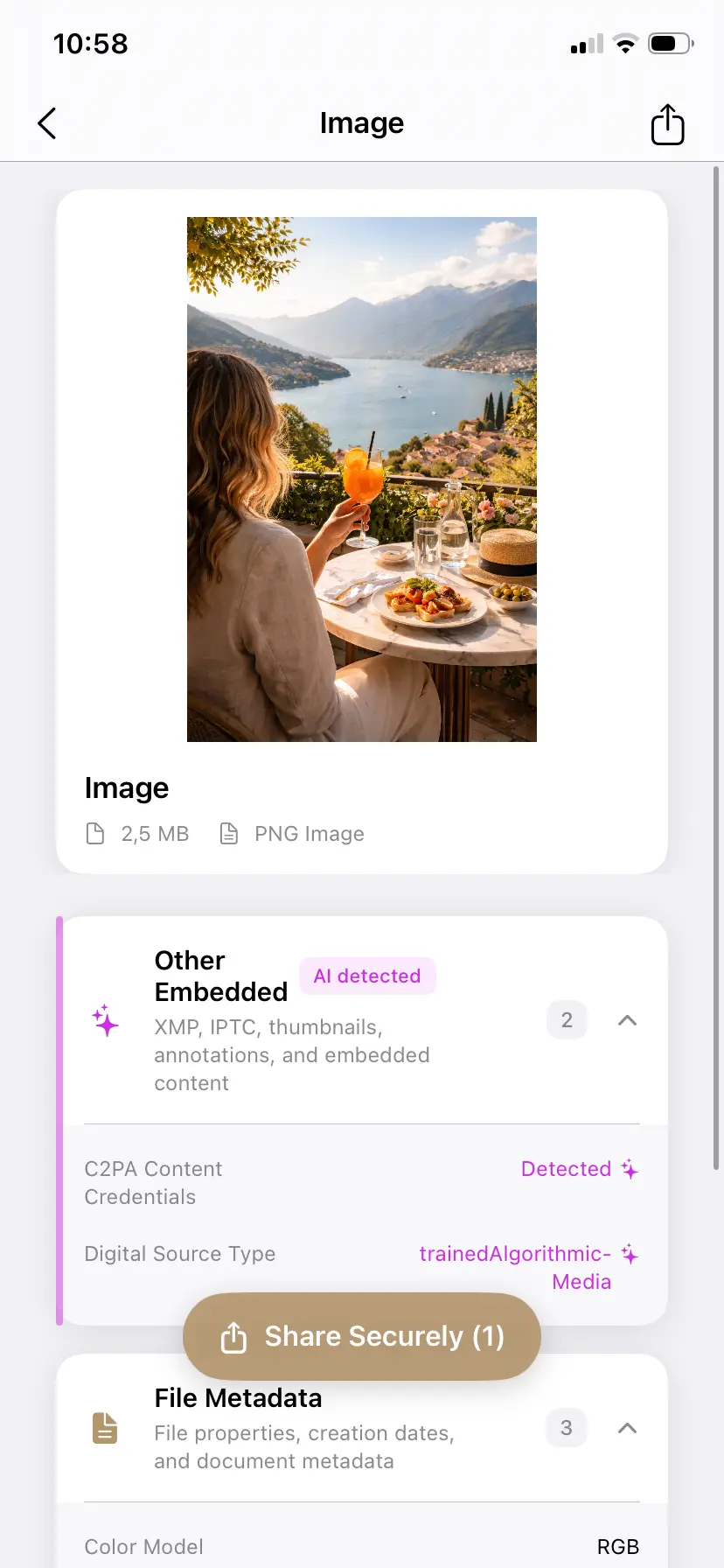
PrivyClean is designed around inspecting before acting: you see exactly what AI metadata is present, which tool created it, and what platform signals are in the file — before deciding what to do. This is more valuable than blind removal because it supports informed decisions rather than guesswork.
For an EU compliance context, that means you can confidently verify that AI metadata is present before deciding to keep it (disclosure) or remove it (where appropriate). You are not guessing whether a file carries a signal — you are checking.
Related guides
- EU AI Act overview: the full picture
- EU AI Act for photographers: Photoshop false positives explained
- What is C2PA? The standard platforms use to detect AI content
- Why Instagram labels photos as AI Generated and how to fix it